Thursday, November 20, 2025

When We Were Google

 When We Were Google

                                              
                                                     photo by Chris Morland


     It is only 46 years ago but this is like describing the time of the Plantagenets when recalling life in the big library before the fire. It was an age long ago when computers were a rumor and hard copy was the only copy. You could say we did present as the houses of  Lancaster (Los Angeles Public Library) and York (Los Angeles County Library.) These were the heavyweight systems who served the largest pool of patrons in the U.S. at the time. Everyone genuflected to the New York Public Library but when they closed up for the  night we got their reference calls from the bars in the city that never sleeps or stops arguing over rivers, presidents and baseball records. I should refer back to the title above when my co-workers and I at Central Library were google when Larry Page and Sergey Brin were in first grade. I confess I started as a reference librarian in 1979 with an MSLS that required a class in computer application. We made punch cards and studied Cobol and Fortran. The only windows I knew was a drug slang from the 1970's. Sometimes we clicked when we squeezed a metal cricket to call a messenger clerk to the desk. To begin in the beginning with the luckiest stroke of my life I was hired to  join the History Department at Central Library where my Mom had once done her homework as a student at LA Poly High School in 1933. I went to library school on a whim and working at Central library was like any little leaguer hoping to pitch in Dodger Stadium. In a stunning set of circumstances I was sitting at the old reference desk in what is now the Children's department but was History on the seond floor, wedged between Literature and Social Sciences. We sat on tall stools, answered rotary telephones that rarely stopped ringing and fed periodical requests into lampson tubes that sent a capsule whooshing up  to a magazine pool a floor above us. There was a creaky dumb-waiter that delivered said magazines where most of the book collection was hidden from public view. The closest thing to a best-seller we had in History was "the Rise of Theodore Roosevelt" by Edmund Morris. The reading room with the famous murals was filled with reference tools and wooden card catalogs for our department only. The open stacks were more like apetizers placed  out to whet the appetites of hungry readers. The reading room with the tall windows facing out on Hope street was filled with a jumble of serious scholars, movie gophers, immigrant students and mentally ill street people mostly minding their own addled business. At one end of the lengthy space was the wonderful California Room and the ubiquitous walking encylopedia clerk Tom Owen sitting at his Underwood Universal typewriter. Tom was a character too big to tackle here but maybe later. Because eager wannabee Hollywood directors were prone to toss reference books off the balconies to nefarious co-horts below the doors to fresh air were wired shut giving the room a distinct smell and temperature in Summer. There were stairs at the  back of the room that lead up to the "work room" where staff sat smoking cigarettes and describing that days adventures. Most of the action took place behind the reference desk in a cramped space filled with the clacking of typewriters and pushing and pulling of catalog card drawers. Microform was a rather new idea to reduce space that was in short supply at Central. In the closed stacks behind this center a level below were matching circular configurations known as "the Hole" and the beginnings of an awesome Biography section that wound through 8 layers of shelving. You could find everything ever written about Alexander the Great in there but the 1926 electrical setup kept the light bulb wattage reduced so reading dewey numbers on a 13 digit World War II book was not easy. There were eight tiers of fragrant books overflowing the not terribly well designed library and a basement where areas were named Rat Alley and Baronial Hall. I know why the rat but not the Baronial. Up top was Administration, Personnel, Cataloging, Bindery, Accounting, the Business OFfice, a lunchroom and a little room where the most excellent Pearl operated the Switchboard. Pearl was the brain that directed a staggering amount of questions into the phone lines of departments. She also knew everything about Central library, especially which parking space might be empty on a given day because someone called in sick. Pearl was revered but not feared as she was a lady with manners and plenty of smarts.

      Just sit with your phone in hand today and pick random words to google and see the kind of odd stuff people are curious about. "Do you have a 16th century map of Iran with treasures shown on it?" We opened at 10 am and the inquiries came out of the chute like angry bulls looking to draw blood. Remember too that this part of entreating humanity was comprised of the ultimate cross-section of Angelenos. There were kids hardly able to form sentences who might have hit redial, lonely old people who wanted to shine at the bridge game speaking authoritatively on the Peloponessian War or students who had to hand in a paper the following Monday. "What time is it on the Moon when it is noon here?  "Was Columbus wearing cuff-links when he discovered America?" "What did Madame Pompadeau do? On a reference desk at Central you got in your steps as the books were not on a little screen but maybe six tiers above you. There was also the dreaded human error factor including mis-shelving and mis-reading shelves. The questions ranged from scholarly to "World Book questions" meaning you could find the capital of Kansas under K. On night shifts we got the saloon arguments when you had to repeat the answer twice since one drunk would not believe another drunk who held the phone. Yes, the Nile is the longest river in the world! No, John Hanson was not really the first president. Maybe Adolf Hitler liked to dress in women's clothing. You also got to learn about weather in other parts of the country as their libraries closed ours was open for business until midnight in New York City bars. Mickey Mantle was born in Spavinaw Oklahoma!  A skilled reference librarian like the ones who trained me could juggle several calls at once and you had to pay attention to the recipient of your answer. Thus, telling someone on the line about Josephus when they wanted to know the name of the newspaper in New Orleans might be a bit awkward. Sometimes you could trust your own experience "How do you spell Utah?" We made some mistakes, we were the humans callers want to speak to today when they call their bank.

      I am actually sentimental about the old reference collections that included card files containing precious shortcuts to stuff like "where did California get it's name? Or what is the longest street in LA? Or when did the Herald and Examiner merge? About the time I came on board we had librarians who clipped travel magazines and created vertical files about destinations. Also, one of the greatest creations of the library was and remains the  California file, just chock full of local histories and detailed biographies way before there was Wikipedia. There were little cards about gunfighters and sheriffs, geographic atlases, Kings and Queens and the grandpappy of them all "The Information File" that met an untimely death at the hands of a clueless modernist. Most of all there were thousands of books, glorious sets of encyclopedias and collected biographies and indexes that presented a possibility of anwering the hardest questions. To list just a few. Many of these books still sit on shelves where they have been undisturbed for decades but more than a few are still invaluable. Granted, many of these sources have become databases but they require fees and in the old library we paid for the book and answered the questions."What is a person from Liverpool called?

Guide to Reference Books- known by editors Eugene Sheehy after Isadore Mudge after ConstanceWinchell  To begin at the beginning the Guide to Reference Books was an essentail authority to the best places to get answers. Depending on how old you were when you went to Library School they were just referred to as Winchells, Mudge or Sheehy.  If you made it into Sheehy you were a big time reference source.

Readers Guide to Periodical Literature: for at least 30 years I repeated thousands of times how you searched for articles in magazines listed by this dear old set and what the arcane symbols meant. To tell the volumes and numbers, pages and illustrations seems simple but...The Wilson company started publishing the indespensible set in 1901 and it  helped educate generations of Ameicans up until they thought that google told them everything they needed to know. They could be rather snooty in what they covered and Playboy never made the cut. As time went on less and less students asked for the guide and an unbelievable amount of them did not know what an index was before standing at our desk. Before 1901 it was Pooles but only for the stout-hearted. "What president threw out the first ball in professional baseball?

Biography Index took the Readers Guide and extracted just the people part.

NY Times Index the newspaper version of a thorough index of important articles. Since many newspapers including the many Los Angeles ones did not have indexes the NYT was the place for solid coverage. There was an index to the Times of London but it was so complicated it was used only as break glass in emergency situations.

Dictionary of American Biography the superb source of no-nonsense sketches about important Americans with bibliographies. No influencers, celebrities or pretenders but very short on women.

Books in Print title tells all

Ayers American Newspaper guide essential for finding obscure historical newspaper that a patron might want to search for genealogy or local histories. It takes it back to the Boston News-Letter of 1704

Who's Who  listings for British luminaries but branched out a bit later on. To get into the real deep weeds of the aristocracy you would have to brave the almost impenetrable Burke's Peerage  When the guy next to you at the bar in Musso and Frank's claimed he was the Viscount of Beaufort you could look him up if you dared.

Who's Who in America  was mostly handy for checking birth dates and places for notables. George Santos would have been found a bounder here.

Who Was Who  There were several sets covering time frames but this was excellent for certified dates and prominent figures now forgotten.

Hollywood studios and television productions checked the use of names of their characters to make sure there was no serial killer named Joe Blow in Omaha for example. The Who's Who covered areas in detail so you could check "Who's Who in the West" etc. In a large library like Central we collected materials from all over the world i.e. "Quien es Quien" etc

Facts on File  one of the most useful and important sources on any reference desk worth it's salt. These gave a condensed version of events during a given week. Thus you could determine the exact date when Nixon resigned or who played for the NBA championship in 1971. It was what was called loose-leaf and sections would be snapped in and at the end of a year bound as a whole.

Index to Women from Ancient to Modern Times-  researchers who tried to study women's history always faced a daunting task of digging out facts from  patriarchal mountains of printed material. This source gave the topic a clearing house of places you might get info on the accomplishments of women. None of that weaker sex stuff here.

Kane's Facts About the Presidents  beyond the encyclopedia briefs Kanes gave you lots of essential information including even physical characteristics and in depth examinations of their lives before the White House.

American Guide Series (WPA Guides) Excellent coverage of each state in the Union done by historians who worked for the Works Progress Administration as part of the New Deal. Here you might find facts about the Hoover Dam next to the population of Hell, Michigan. There is also a WPA guide on Los Angeles alone.

Chase's Almanac  tells you what is notable for every day of the year and why holidays are celebrated on certain dates. Milestones are here, birthdays of the famous, and festivals. What day is National  crouton day?

People's Chronology by James Trager is a fantastic listing of historical events from prehistory to the present. You might know the Battle of Hastings off the top of your head but do you know when the Seneca Fall Convention took place? Trager does.

Bartholomew Gazateer of Great Britain and Ireland Old time genealogists bow to Bartholomew where the tiniest dot on a Ordnance survey map appears with an explanation, situation and relation to landscape. The essence of authoritative since 1904 when it appeared as six volumes.

Columbia Gazateer of the World  You know you have big ambition when you take on the world but this tome covers the globe with a fine-tooth comb. Using their own words the source covers demography; physical geography; political boundaries; industry, trade, and service activities; agriculture; cultural, historical, and archeological points of interest; transportation lines; longitude, latitude, and elevations; distance to relevant places; pronunciations; official local government place-names and changed or variant names and spellings. Whew!

Rand McNally Commericial Atlas and Marketing Guide  Everything you need to know about every damn state of the Union including the population, rail connections, county seats, rank in state. One heavy book that determines how close you are to retirement if you can or can't lift it

California Place Names- Gudde origin and etymology of the names of places in the Golden State. Ever wonder why Fontana would change their name from Rosena? Me either but it is in  Gudde

Tooleys Dictionary of Mapmakers  Being a map librarian I had to learn about mapmakers but fielded very few questions about my heroes. You might know Mercator or Ortellius or Bleau or even John Speed but Tooley records for posterity all of those crazy cartographers going back to Claudius Ptolemy who came up with latitude and longitude.

Times Atlas of the World  while there are scores of fine atlases of the world, if you want to start at the top you would check out this preeminent look at the globe. You can't help but lament that we made such a bad job of keeping this treasure in good health

Kings Rulers and Statesmen great one volume guide to rulers of countries including the dynasties of Egypt and China. It was here I learned about Ethelbert and all the Prime Ministers of Canada.

Los Angeles A-Z  Nowadays the internet is swarming with "experts" about LA but back in 2000 Dr. Pitt was the go-to guy for the LA stories. A great place to learn that LA history is not just the Black Dahlia and Hollywood Movie Stars.

Out With the Stars Hollywood Nightlife in the Golden Era- Jim Heimann  one of the rare but wonderful limited edition from Dawson's Bookstore. Heimann, the master of  local history images created a book that reflects the dream of Hollywood life that really only exists for an elite few. Very popular book

 Clencia Heraldica o del Blazon- Alberto y Arturo Garcia-Carafe a simply magnificent 40 volume set of Spanish coats of arms that was so protected patrons had to leave identification at the desk just to take a peak.

 Sheperds Historical atlas amazingly complete collection of maps showing historical geography from Ancient Greece up to the Panama canal zone. There are many historical atlases but Sheperds was the granddaddy of them all.

Fannings Illustrated Gazateer of the United States- published in 1853 this precious book lists American place names in great detail and describes counties of the 31 states including the whippersnapper California as number 31

Hand-Atlas über alle Theile der Erde und über das Weltgebäude or as we called it the Stieler Altas of 1891  The best German atlas at the latter part of the 19th century so it is invaluable finding places lost in the two wars. The cartography is superb and the index lists very small villages.

Distances Between U.S. Ports- today you might use your phone but in the hard copy days such information was damn important and there were maps!

US Board of Geographic Names- with the finest of fine tooth combs these state my state books listed all geographic features. Not just cities or rivers but camps out in the middle of nowhere that no one knew existed except the Board.

and just for some icing some of the winners from my short stay in branches

PDR physicians desk reference showing actual pills for medications with side effects and such before drug companies had to put all that stuff in with the drugs

Value Line investment research dating back to the 1930's this was a must read for investors before the coming of on-line guessing. It tracked 1700 publicly traded stocks and we had to interpret symbols to folks who knew way more than we did about the stock market.

The Stateman's Yearbook- had been listing current facts on countries since 1864 Political, Economic, Cultural and social conditions everywhere in the world. In one book! 

O.E.D. or the Oxford English Dictionary the final word on the English language in print so fine they gave you a spyglass to use for examination. This magnificent work traced the creation and use of a mere 600,000 words in English.

Bartlett's Familiar Quotations  in the beginning Bartletts was so ubiquitous it was just known by the first name like a family member. The place to go to answer the dreaded quotation questions.

The Kelly Blue Book  People of a certain age would know the book as just "the Blue Book" that let you know just how little your old Camry was worth.

Contemporary Authors- everything you would want to know about ink-stained wretches who created not only novels, plays, screenplays, short-stories, but journalism also.

Grangers Index to  Poetry "I liked this poem, it was something about birds and death?" With Grangers you have a good shot at an answer plus full text, a bio, and commentary. 

Grove Dictionary of Music If you don't know a largo from an allegro Groves is the place to have the mysteries of music explained beautifully.

Book Review Digest the great rescue for clueless kids with book reports due. In a very easy to use format you would be led to the thoughts of critics who could describe a 400 page book in a paragraph. 

Bullfinch's Mythology probably known by more people than most reference sources the weird world of Greek and Roman myths are explained clearly along with even more obscure tales of gods and godesses from Scandanavian, Celtic and Asian cultures.

etc.

     I salute today's reference desk stalwarts and am not saying we old timers were more effective or intelligent. The current staff of my department is very good and can answer complicated queries in minutes.We in pre-fire Central were more like peach-basket basketball players against LeBron James if you consider the tools the staff have now. Yet, we shot that two-handed set shot pretty well. Once upon a time there was a thing called a "level two question" that was handed over to SCAN who were crack librarians who dug into deeper questions. They had the luxury of quiet study that would not be interrupted by twelve more phone calls. True, many of those calls to our desk were about directions, time zones, dates of holidays and "you have a nice voice" from the LA lonelies. We had a connection with our patrons that will never be recreated I am afraid but it was the books that made us wonderful There are still people of all-ages that find the scent of a book being opened to be comforting or even erotic. 


Thursday, August 28, 2025

Retro 2005 Grover


Grover


     It is with great sadness that I must tell you that the Great Grover, hall of fame pup and beloved Chernoff-Creason family member entered Rainbow Bridge this morning at 11am. Grover was unable to stand on his own power as of last Friday and rallied slightly after a cortisone shot eased the pain in his hind quarters but he had stopped eating and it was feared that he was in physicall distress. My Mom, brother, sister and I stood by him, hugged his eminently loveable face and gazed into his kind, soulful eyes for the last time this morning. It was the last favor for a big guy who has brought joy to all of our family for most of a very sweet four years.

     The grief that his illness brought galvanized the family and brought folks in from all over the area to participate in Grover's farewell tour, which ran over the weekend. Stephen came from Silverado, Christine, Mark, Shaun and Jeff from Placentia, Jill from Riverside with all her kids, and Sunny from Aguanga. Calls came in from Colorado and love sent in e-mail and telephone calls. When his illness would not allow him to stand on Friday evening Cheryl pulled a comforter into the kitchen and slept beside him, comforting him until the morning.  As he was throughout his reign in my Mom's house Grovie was showered with love by all. The kids made get-well cards and never stopped petting him or reaffirming our opinion that he was a good boy, in fact the best boy in the world. Even though he was clearly on his last legs and struggled to get upright, when I arrived and called out to him he jumped up immediately and ran to me with a powerful tail wagging vigorously. I hugged him and held him and let some tears loose for a real dog in a household of his canine admirers.  The ride to the vet was one of the longest with my Mom's sobs taking us deeper and deeper into the sorrow of his passing. Yet, when the anesthetic was administered he took it bravely as always and just went to sleep, peacefully, with no fear or discomfort.

     I may not believe in God or pie in the sky but I do prefer to accept the notion of Rainbow Bridge. I trust he is there now, greeted by Maniac and Lydia who will show him the very best places to make a mark in the afterlife. I would hope Joel is there to take him back where he belongs. The sadness of their last years together were more than made up for by the spoiling Grovie received at my Mom's. Grover was raised with love from his puppyhood and his bad times were relatively few.  Believe me when I tell you that the pleasure was all ours when it came to taking Grover into our family. He was a ray of sunshine for all of us and was deeply loved, not only by the humans but by the animals too. Gracie the dachshund and Grover had a special bond. To see them together just couldn't fail to make you feel great. Grover was much more that a pet, he was a wonderful component of those things that make a home a home. He was the blood of our hearts, an unforgettable, lovely boy.

Tuesday, August 26, 2025

New Ways to Dream

 from the musical West 5th street boulevard

played to the tune of "New Ways to Dream" from Sunset Boulevard the musical


I don't know why I'm frightened

I know my way around here

The reference desk, the carpet squares , the silence here...

Yes, a world to rediscover

But I 'm not in any hurry

And I just need a moment


The whispered conversations in the workroom

The atmosphere as thrilling here as always

Feed the early morning donuts

Feel the magic in the making

Why, everything's as if we never said goodbye


I've spent so many mornings just trying to deserve you

I'm trembling now, you can't know how I've missed you

Missed the email inquiry adventure

In this electronic spinning playground

We were young together


I'm coming out of the cot room

The lights already burning

Not long until the patrons will start yearning...

And the early morning madness

And the magic in the making

Yes, everything's as if we never said goodbye


I don't want to be alone

That's all in the past

This world's waited long enough

I've come home at last!


And this time will be bigger

And brighter than we knew it

So watch me stay awake, we all know I can do it...

Could I stop my hand from shaking?

Has there ever been a moment

With so much to live for?


The whispered conversations in the cubicles

So much to say not just today but always...

We'll have early morning coffee

We'll have magic in the making

Yes, everything's as if we never said goodbye

Yes, everything's as if we never said goodbye...

We taught the world new ways to dream!


Monday, July 07, 2025

Map Collection History

Retro 2004


                   The Map Collection: a Reason to Believe


              “I have an existential map. It has “you are here” written all over it.”


                                                           -Steven Wright 


      Those who toil in the Technicolor weirdness of Central library subject departments probably hear the same ghastly question I do when our occupation comes up: "why in the hell do you want to work down there?"  That one ranks up there with my Mom’s "don't you ever dust?" for inquiries that set my teeth on edge. True, in my time at Goodhue's masterpiece I have seen more than a carnie barker and heard stranger things than any waterfront bartender or prison shrink. Yet, there is another side to this sideshow.  There must be some reason why I have Bataan death marched past the fire, walked over the hot coals of Spring Street and moved through the dark shadows of LL4 to follow the LIII map quest in History. It would be easy to go mad and join the crowd out in Maguire Gardens after some of what I have seen and smelled but we tread the razor blade between madness and enlightenment while tottering on shaky Central legs. Pour a couple of drinks down any one of us and the truth will come out that despite the goofballs we are actually proud of this place if not this time. You see, down here we have the cooling balm of our collections to soothe away the endless hours of handing out newspapers, emptying trans-logic carts and listening to the genealogical equivalent of “Finnegans Wake.”

     With my fellow staff members disappearing like the dark whiskers in my goatee and porn monkeys crawling all over our computer research stations I ask myself the “what am I doing here?’ question frequently.  I could be writing columns on the great new addition to the Cerritos Towne Center, something with Shoppe in the title or reading "Dinosaur Bob and the Family Lizardo" to little tykes in the boonies but instead I am still in the History department. I am here mainly for two reasons: my mortgage and my love of the map collection. Sure, I share my dungeon with some excellent librarians and nice support staff but maps are cool and don't talk back like genealogists. I apologize in advance for the seemingly egotistical, solipsistic quality of this story. The maps and I have sort of become one in the past fifteen years like Chang and Eng.  A friend once described a similar interchange that went  “well enough talk about me, what do YOU think of me?”

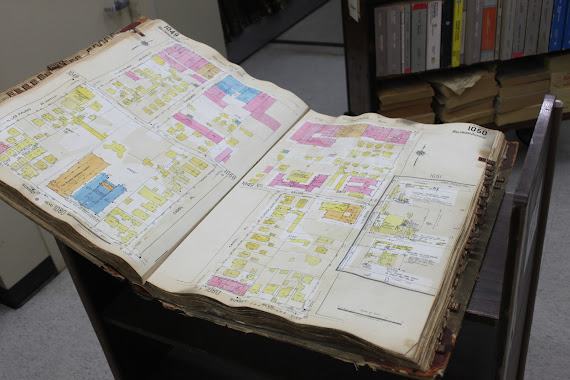
     The Map Collection is something to bust buttons over and it is one hard copy collection that is actually growing and thriving. In the past year we have actually increased our size in Shaq sized leaps, adding many historical foldout maps, several hundred historical topos and sixty volumes of Sanborn Fire Insurance atlases. All of this without spending a penny since all of this largesse came from our public. Like Wynona Ryder we have filled our shopping bag without putting out a red cent.  Try that at Nordstroms.  What is now near 100,000 maps plus a whole lot of other cartographic stuff had fairly humble beginnings. One of the earliest inventories of maps at LAPL was in 1891 where 104 graced the collection. The focus of Los Angeles might have been quite simple, comprised of the original 1849 Ord Survey and a few variations on the four square leagues of the original city.  Before the land booms of the 1880's there wasn't much call for local maps. So few Angelenos inhabited our fair city that mostly you could stand at the plaza and point:" yeah, Mr. Alvarado's place is up on that hill, near Eternity Street just past them sheep up there." Some five years later when the library contained signs that curtly stated "Ladies: this room is for reading purposes, not for conversation" the collection had swelled to almost two thousand.  It was a time of complicated wool outfits worn in summer, before dry cleaning. Can you imagine what a reading room smelled like in those days?

     When the wise ones planned the glittering new library at 5th and Flower in the 1920’s the early blueprints designated a map room attached to the History department. As Goodhue’s masterpiece opened in 1926 there were some 5,000 maps in several departments. The much-revered Mary Helen Peterson who eventually would have the map room named in her honor was put in charge of gathering up all the cartographic materials and joining them in one tidy place. By the time the library was divided into subject departments in October of 1927 the History department was given the bulk of the collection with Science handling geologic and soil maps. Rumor has it that little Roy Stone used to take breaks from organizing the scrolls in rat alley to shelve maps in the five cases we had at that time. Those cases were World War I vintage and had once contained detailed plans of the European theater of battle. Much later, in 1986 the tough old cases would come in handy.

     When WWII arrived it brought an influx of public need to see cartographic documentation of the theaters of battle and the countries on both the Axis and Allied sides. The addition of the whopping Army Map Service map collections and the status of government depository of these official maps gave rise to a separate map facility in the History department called the Army Map Room. The Map Room was one of those eccentric little cubbyholes in the old building that was both creepy and quaint. It was small, cramped and overflowing with backlogs of all sorts of maps arriving like spam in an AOL account each day. This eccentric little space had a nobly institutional character with a steep ramp downward to the magazine pool, sunlight that cascaded through a pair of smudged windows and drawer upon drawer full of mysterious treasures seen mostly by the staff and a few dogged patrons.  Downstairs, where the Ronald McDonald Children's Charities Southern California Multimedia Center (try to say that after your second margarita!) sits today were large wings or binders containing attached USGS topographic maps of California. Of course, those of Hollywood or Los Angeles were more often in somebody's den since they were frequently torn out for souvenirs of a visit to the Central Library. Some things never change.

     In June of 1949, the first of two map mavens took the reins, as Anne Mueller became librarian in charge of the map room. Miss Mueller was responsible for much growth and conservation of materials while building the Map Room into an important reference source for the West coast. In 1958 Bill Wise was brought in as a library assistant and began a distinguished career preparing, indexing and servicing the collection. The distinctive handwritten notes of Mr. Wise still direct patrons and befuddled librarians to find the answers in a haystack of sizes, shapes and applications. On January 27, 1971 the Army Map Room was officially designated as the Mary Helen Peterson Map Room. Peter, as she was affectionately called by staff held the collection in good stead between puffs on her camel cigarettes for the rest of her fine career in History. However, like most of pre-fire Central the map collection was not easily accessible to the public and the need for a subject specialist in the field gave rise to the position of Map Librarian that was given to Dorothy Mewshaw in 1970. Dorothy, my predecessor was known for her sharp mind, organizational skills and large ubiquitous bags that she hauled. No one knows exactly what was inside those bags but one can assume much of it was about maps and mapping. When Miss Mewshaw handed me the reins she held more map knowledge in her little pinky than I had in my entire head.  She was more than ably assisted by Dennis Alward, the library assistant for the map room who left a legacy of detailed and insightful suggestions on how to use the collection. His profuse notations include how to fold them, how to treat them and how they compared to other sources and editions. The man drank a lot of coffee and loved maps.

     On the terrible, terrible morning of April 29, 1986 arson fire started in the stacks of Fiction, next door to the History department and swept westward through the tinderbox of Central's stacks. The inferno blazed across the magazine pool, passed directly through the upstairs map room and on toward the ultimate obliteration of Science, Social Science and the Patents room. When hundreds of broken hearted library staff waded in the dingy water the next day Dorothy darted up the stairs to find the Mary Helen Peterson map room pretty much intact. By the miracle of the robust WWI cases most of the collection was unscathed, save a few smoke stains. One exception was the irreplaceable roller maps which were scorched in the closed stacks of History near the 92 N's that went to book heaven, followed by oceans of the saving waters of LAFD fire hoses. Maps that were as large as a wall went down to the arsonist's evil but many were saved. Without hesitation, Dorothy Mewshaw and her now intrepid assistant Roselynn Lee started to ensure the safety of the collection with an inventory upstairs and downstairs. Dorothy treated each one with the delicacy of a nurse in the maternity ward.  Like the rest of the gold in Central the old friends took a holiday for several years but one fine day in 1988 they came back home and were unloaded hand over hand by the crack movers of Crest. Maybe it was the crack-smoking movers. Seems they weren't too familiar with the concept of filing and hand over hand meant an entire collection was now snug in drawers like a tossed salad. Luckily Frank Louck was in the house and the History department hall of famer meticulously put the piles back in order, drawer by drawer by drawer by... Frank was a patient man; after all, he supervised me for twenty odd years.

      When the library finally opened their doors on Spring Street the maps were placed in a public area on the second floor.  This set up problems never before seen by the collection that had been protected like a Jewish grandchild. The rowdy chess games that raged on the border of Art and History often involved the use of topo maps as sketch sheets, place mats for illegal lunches and even impromptu megaphones for one group of library delinquents. In these uncertain and confusing times Dorothy Mewshaw saw it through to 433 Spring and decided to go no further. Like Roberto Duran before her she dropped her gloves and said “no mas!” So, in a fierce battle for the  “Subject Specialist in Maps” job I was chosen to carry on the torch that had been so nobly gripped by the likes of Anne Mueller, Mary Helen Peterson, Bill Wise, Dorothy Mewshaw, Dennis Alward and Roseleynn Lee.  Competition was stiff, I was the only applicant, they gave me the job and was ridden through the streets in triumph by my friend Teresa. I could recount how I was not a map person, knew next to nothing about the science of cartography and was only in it for the money but you can read all that on my tiny slice of a buddy's website at http://www.garbell.com/creas/creason-smile-und-Sp99.html   In a nutshell, I was a freshly hatched egg and I had to take each and every map from the drawers and find out what it did and why it was here at Central. It took me several years to scratch the surface and during that time I fell deep in love with pictorial maps. That has little to do with this article except that this love finally was consummated by an exhibit at Central library and an article in the Mercator's World magazine: September/October 1999. For fifteen seconds my map collection was famous and appeared in two newspapers, one radio program, Los Angeles magazine’s to do list and the WAML Bulletin (the Western Association of Map Librarians.) This also meant I was photographed in my Harry Potter-like round spectacles, a holdover from the 1980's. My daughter has never let me forget that.  Despite my many entreaties to Toria and LAPL bigwigs to have another exhibit of my maps my career seems to be as dead as Millie Vanilli's. I can't even get on the card at Branson, Mo.

     Anyone who wants a tale of the map collection in a succinct fashion can always look at http://www.lapl.org/guides/map_coll.html but that really doesn’t tell you how these letters on the screen can help in answering reference questions or helping students gain some understanding of history. We have about 100,000 maps now, the bulk of which are United States Geological Survey topographic maps of the entire country. They typically cover about 64 square miles per quadrangle and show the physical features of the landscape. The library keeps all USGS maps on California even after they are made obsolete by newer editions. Older topo maps for California are placed in a precious historical file. Discarded maps of other states are used to wrap my Christmas presents each year.

     There are nautical charts of both domestic and international shores. The National Oceanic and Atmospheric Administration creates the ones of say Santa Monica bay and the Defense Mapping Agency would get you the coastline of any country you wanted to invade since they had weapons of mass destruction or something like that. In the same vain we also have aeronautical charts for air lanes across the globe and as close as the horrors of LAX. Of note and frequent use is the Army Map Service map collection that pretty much got LAPL's map room on the map. These dandies from the late 30's and 40's are detailed topographical looks at places that no longer exist in the case of bombed out Europe and are favored by genealogists trying to find Uncle Heinrich's birthplace and historians trying to determine just who ruled Danzig when. In the new and improved drawers you will find other curiosities and useful cartography including detailed maps of the Vietnam war, maps of the U.S -Mexican border, maps of the United Kingdom, Canada and even Antarctica. Once, I found chicken bones and a Penthouse magazine in the atlas cases.

     For local history, Central has an impressive map archive that can even be considered fun stuff at dinner parties. Here you will learn what charming name your neighborhood had back in the old days. It might be Zelzah or Garvanza or one of my favorites: Mesmer. You can see where the streetcars ran, follow the Zanja Madre through the Pueblo or even discover exactly where those good time houses were in old Chinatown. There is a fine copy of the copy of the Ord Survey of 1849 that Colonel Ord marched over the saw grass of the old town to measure and a roller map of East L.A. that even City Hall's sacred map vault did not own. There are maps of California when it was thought of as an island, atlases showing the immigrants best trails westward post potato famine and auto club foldouts and street guides taking us back to before Central stood at 630 W. 5th street. H.H. Stevenson made a fascinating color plat map which shows the owners of the tracts around downtown done in 1888 which is astounding in its detail and Hansen's county-wide from the 1870's shows plainly how the city began as a block at the Plaza and then tilted at Hoover and became a grid. Another dear treasure is a minutely rendered Birdseye map of the city done in 1909. Every building from the courthouse to that so called University down by the Sizzler sits in relief.

    Probably the most rewarding of all resources are the Sanborn Fire Insurance atlases that show us neighborhoods in great detail as far back as 1888. One of the many wonders of Sanborn research is the old-fashioned serendipity of discovering what was in a hood at a time lost from personal memory. The irony of the site of Central library once being inhabited by “the Normal School” never ceases to amuse me. When Historic Resources Group gave a gift of some sixty volumes of these beauties to the collection this Summer it gave new meaning to urban discovery. Seeing the familiar volumes covering places like Hollywood, Glendale, Venice and even my own Glassell Park in living color with little patches of pasted over corrections on the sheets makes history come alive. Patrons who labor under the hallucination that somewhere there is a history of every house on planet earth might even be astounded to see their dear little craftsman actually on the map right next to the tuberculosis hospital or a school for wayward girls. It further amazes me to encounter the occasional Silverlake hipster-historian who views the 1950’s in L.A. as if it were a time when saber toothed tigers roamed wild and wooly mammoths thudded down Figueroa.

     The map collection is not just a bunch of paper stuffed in musty old drawers. It is a living and breathing resource that can give insight, answer mysteries and explain the path of this ramshackle city some 200 plus years after the fundadores picked a cozy place near the Porciuncula River. It is detailed Gillespie, Renie and Thomas brother's street guides to the county going back to 1925. These dandies will show you stuff like the location of Wrigley Field where the PCL Angels played or Queen of Angels hospital where millions of Angelenos first saw the world. They contain not expected answers to phone exchanges, early postal codes, pre-freeway neighborhoods and the dreaded street railway questions. LO-67773, yeah that was my phone number back when those mastodons roamed. There is also the incredible microform set of Historic Maps of Los Angeles that reach back to the mid-nineteenth century and provide printable maps of everything from lovers lane in 1871 to the Payne map of downtown done in 1931 showing each and every building including the cool Hamburgers Department store. Want to trip the light of memory fantastic? You can pick up the Nirenstein atlas from those far away 50’s that gives a plat map and aerial photo of prime retail streets on the west coast including Broadway, Hollywood boulevard and North Hollywood’s Lankersheim.

     This could go on and on like the thousands of sheets of history held in these atlases and map sets but I really should return to the original thesis. You can explain it all in intellectual terms but the reward of the struggle is evident in one little story. Once upon a time I went drawer by drawer looking at each and every map we owned. Things like the pictorials broke up the boredom and others claimed a spot of fascination in my imagination. All of this scrutiny paid off one sleepy Tuesday afternoon in the mid-90’s.  A dapper Chinese gentleman asked if we might have a map of Shanghai before the Japanese occupation. A little spark fired back in the vestiges of my brain and five minutes later I spread out a glorious map done of the old city in 1934. The man’s face literally glowed as he bent to inspect this rare thing, so long forgotten in the drawers. I returned to mundane tasks for a few minutes and returned to find my patron with tears streaming down his face. This humble sheet of paper, filled with symbols of a city seventy years lost unlocked some sweet memories, sweet enough to bring him back to his childhood and the joy he knew in Shanghai once. He held my gaze and shook my hand with vigor unexpected from a gent of his years. He thanked me, he blest me, he explained about losing his sister in the war. This “A new directory map of Shanghai” by Chia-yung Soo took him once again to the streets he had shared with that sister, to places of joy and innocence.  The ghastly “why do you work down there” question was answered for me in the gratitude of this gentleman. What he took from our library was dear to his heart, dear indeed to all people everywhere. 


Tuesday, July 01, 2025

The Things He Handed Down retro 2006


The Things He Handed Down


     Once a year the greeting card folks make a buck on a jejune holiday dubbed father’s day.  Compared to the Super Bowl of parental celebrations: Mother’s Day this one goes off like a preseason semi-pro game in Keokuk.   A few lucky Dads will get breakfast in bed or a trip to the IHOP but for the most part this day is only a period of nods of approval and allowances for Pop’s annoying idiosyncrasies. In television and film most Dads are portrayed as hapless oafs who need close supervision or they will burn the house down making toast.  Then again, many of my male role models could not make toast without a spouse’s intervention.

     Yet, as I look back over the mists of the twentieth century I begin to understand some of my own father’s influence. I inherited many a trait better left behind but I still pull a boxcar full of his best stuff. I snore like a beast, do too much sport eating, like wine a tad too much and have a temper best suited to professional wrestlers and Jack Nicholson roles. I also am butter soft around the heart, a sucker for girl’s tears and furry creatures. Maybe I love my Dad more now because we saw his big ship steam off into the sunset back in 1992, leaving all of us in the leaky dingy of our own adulthood. Life hasn’t been quite as easy or fun since.

     The current culture is cancerous with lousy, non-participant fathers, those selfish bums who procreate and vanish. In my opinion, this sickness is responsible for a country-full of social ills and degradation of morals and manners that lie in the laps of these absentee cowards.  It’s not the TV, the celebrities or the Internet that breeds criminals, cheaters, gangsters, SUV bullies, cell-phone boors and hooligans. Fathers are the foundation on which responsible living is built; their roles cannot be underestimated. Those of us who have lifted up our kids to see the monkeys at the zoo or got a squishy hug from our own know just what these no-show fools have missed.

    With that seriousness in mind I reflect on my own Dad, with his copious flaws and depression-era values that drove us crazy for a half century.  Despite his occasional meltdown with neck tendons tightening and forehead veins showing he imparted many a balance to the hard world we often encountered over our lifetimes. What he gave us continues to grow in importance, growing like an old garden full of fragrance and loamy goodness. These include a love for musical theater, which was cemented by repeated visits to the Biltmore Theater and “Fiorella,” “My Fair Lady,” “Bye Bye Birdie,” “The Sound of Music” and even the terrors of “Hello Dolly.”  To this day, my totally tone-deaf brother can take a whack at  “Poor Professor Higgins” because of those magical moments out in the audience.  Imagine the thrill for kids raised in front of the five-inch screen black and white television to see an entire stage full of beautifully costumed singers belting out  “Climb Every Mountain.” Because of him we love music and theater and arts they never knew existed back when the Biltmore shone that original light on our little souls.

     The Old Man, as we never called him to his face was also a generous and wise soul who parted with his money easily in the face of a sad story. The lesson was that money and keeping it is never as important as sharing your good fortune. Today, as millionaires proliferate and charitable donations dwindle I often hearken back to my Dad’s modest holdings and copious donations to everybody from broke ex-pugs to the crippled children’s Rams-Redskins charity game. We didn’t have to know Barney the purple dinosaur to visualize sharing; it was part of our lives. We don’t have much but it has never killed us to part with it either.

     While my Dad wasn’t educated past Huntington Park High School he could tell a story when he felt like it and left behind some pretty good epics. He also pronounced chile relleno like “rell-lenno” but could take you to a great restaurant in any city within one hundred miles. He had a homespun, direct approach to communication and gave me the greatest compliment ever by telling me I was the pick of the litter when it came to creativity in the family. Since he loved dogs beyond anything reasonable in this world this had a depth of feeling that lasts.

     Lastly, he taught my brother and sisters and I about responsibility despite his angling to get the most out of life and his loose interpretations of the rules sometimes. When I bragged about hoodwinking a high school teacher to avoid some character-building work he forced me to get on a bicycle, peddle four miles and admit my mendacity to the same teacher. That wronged teacher, Mr. Heideman, mercifully accepted my apology and then sentenced me to three hours, hard labor on a precious Saturday. The character building was only postponed, and then reinstated by the Patriarch.  Our childhoods, seemingly over in several sweet heartbeats were filled with this influence of morality that sometimes gets lost today in the flood of electronic hyper stimulation.  Today I look back at my Fathers days and long to tell the old guy I finally understand what he meant, even if he did pronounce relleno all wrong. There is a song that says it too:


”You may not always be so grateful
For the way that you were made
Some feature of your father’s
That you’d gladly sell or trade

And one day you may look at us
And say that you were cursed
But over time that line has been
Extremely well rehearsed

By our fathers, and their fathers
In some old and distant town
From places no one here remembers
Come the things we’ve handed down”


Glengarry History department 1996

 retro 1996


Monday morning- History and Genealogy, Social Science Philosophy and Religion workroom. Bob Timmermann paces about as Glen Creason, Michael Kirley, Glenna Dunning and Carolyn Cole straggle in. They are waiting for Cynthia McNaughton but Timmermann grows impatient. He speaks to Linda Moussa:

Bob: “Well, I’m going anyway. Let’s talk about something important. PUT THAT COFFEE DOWN. Coffee’s for closers ONLY! You think I am fucking with you? I am not fucking with you. I’m here from the fourth floor. I’m here from Cecilia and Anne. I am here on a mission of mercy!

Bob: “Your name’s Creason?”

GC: Yeah

Bob: You call yourself a librarian you son of a bitch?

GC: I don’t have to listen to this shit.

Bob: “You certainly don’t pal. Cause the good news is that you are fired. The bad news is: you’ve got, all of you’ve got just one week to regain your jobs. Starting with today, starting with today’s reference desk.

Bob: Oh, have I got your attention now? Good, cause we’re adding a little something to this months reference contest. As you know, first prize is a happy donut. Anybody want to see second prize? Second prize is a sour ball from Cheryl’s desk. Third prize is you work desks with David Brenner.

Bob: Do you get the picture? You laughing now? You’ve got the desk tools,  Susan and Cecilia paid good money. Get their questions and answer them. You can’t give them full text, you can’t  find census EDs, you can’t find Sanborns, you can’t find shit. You are shit! So hit the bricks pal and beat it because you are going out!

GC: “the online periodicals are week.

Bob: The online periodicals are weak? The proquest is fucking weak? You’re weak! I’ve been in this business ten years.

MK What’s your name?

Bob: Fuck You! That’s my name. You know why baldy? Cause you drove a Ford Probe to get here today. I drove a Toyota Camry. THAT’S my name!

Bob: (turns and points to Creason) And your name is you’re wanting. If you can’t play in the man’s game , you can’t remember the details, you go home and tell your cats your troubles. Because one thing counts in this life: get them to leave the department. You hear me you fucking faggots?

Bob: (at the blackboard) A, B, E…Always…Be…Evasive  A, I, D, A…Attention, Interest, Decision, Action! Do I have your attention? Interest: are you interested in hard copy? I know you are because it is fuck or walk. You close questions or you hit the bricks. Decision, have you made your decision for Christ? And action like the ALA.
Bob: Get out there. You got the genealogists and internet bums coming in. You think they came in to get out of rain? A guy don’t walk in the reading room lest he wants to inquireMK: you're such a hero, you're an acting senior. How come you come down to LL4 and waste your time with such a bunch of bums?

Bob: You see this Nakamura bobblehead doll?

MK: yeah

Bob: That doll cost more than your pink plastic tote bag. I made $50 a game on stringing last year. How much did you make? You see pal, that's who I am and you are nothing. Fussy guy? I don't give a shit. Good pet owner, fuck you, go home and play with your cats.  

You want to work here, close questions. (walks over to Glenna) You think this is abuse? You SPNB-ite. You can't take this, how you going to take the abuse you get on a desk. You don't like it? Go work in Soc or Infonow.

I can go out there right now, the desk tools you got, and answer like twelve gen or map questions in one shift. Can you? Can you? Go and do likewise. A I D A Get mad you sons of bitches, get mad!

You know what it takes to work reference desks? It takes brass balls to hand out newspapers and empty trans-logic carts. The nuts are out there, waiting to give you their psychotic rambling. I've got no sympathy for you. Antlers, Evil, Frevele, the Genealogy bum, the chairman! You want to go out on those desks today and close questions, close, it's yours. If not, you're going to be ironing my shirts. And you know what you will be saying, a bunch of losers sitting around McCormicks: "oh...I used to be an reference librarian...it's a tough racket."

    These are the new databases. The Glengarry databases. And to you they are gold and you don't get them. Because giving you access would be just throwing them away. They are for closers. I'd wish you good luck but you wouldn't know what to do with it if you got it.

(Walks back to MK to get his Nakamura bobblehead) And to answer your question about why I am here. I came here because Anne and Cecilia asked me for a favor. I said the real favor, follow my advice and tranfer all these losers to Ascot branch because a loser is a loser.


Saturday, June 28, 2025

My Friend Teresa- 2000

 retro 2000


                        “My Friend Teresa”


“If I could forget to breathe
It's happened down through history
And surely I could lose my head
Some night I could drink too much
And take it off and just forget
And I will learn all languages
I will speak in every tongue
From highnesses to savages
And to all beneath the sun
 
Someday I will paint the sky
I will build a ladder, make a roller
That could reach that high
 
And nothing that I do will pass
Everything I will and make and feel
And dream and know will last
 
I will rid the world of sorrow
Stop all wars and pain
I will tell you of tomorrow
As I rule the wind and rain
 
I can do it all it's true
But only when I've done all that
Oh will I turn away from you
Only when I've done all that
Oh will I turn away from you
 
“If I Could Forget to Breath” by John Gorka
 
     The last time I saw my friend Teresa I went home and piled up my photo
 albums and I took a trip through the past thirteen years. That was the short,
 happy stretch of years in which I made the acquaintance and then achieved the
  lasting friendship of this rare and wonderful woman. There she is at the
 circulation desk in her pink triangle t-shirt. There loveseat lounging at my
 Christmas party.  There at a long-ago birthday in rainy Pasadena.  There
 dancing a graceful meringue with Beatriz.  There tearing into a Dodger dog at
 the Opening day of the baseball season.  There hugging my little daughter. There she is; forever young, forever beautiful, forever full of life. It is no coincidence that she seems to be at the center, in the middle and
 always, always lighting up the frame with her resplendent smile. It wasn’t
 because someone had just said “say cheese!,” she just loved being around her friends. Hers wasn’t just a smile, it was a
 supernova! She had a joy , a robust, positive attitude that was a tonic for
 everyone around her. When I say “my friend Teresa” I do so with a pride and
 love that is unbounded by mere words. When I say “my friend Teresa” I feel
 the joy of her presence in my life again, a presence that has enriched me and
 my family immeasurably over these past thirteen years. Teresa wasn’t just a
 person you got to know and forgot, if you knew her, truly knew her, you would
 love her and never want to let her go.
      It seems like yesterday when I went to visit her and her partner Eva and we fed Mr. Bunny milano cookies together. It seems like yesterday that we traveled to Chicago for a Wrigley field holiday. She was fearless, she brought adventure to my days, she took me places I never would have been: like next to Vin Scully in the most precious photo in my collection or amongst 300 sweaty, dancing women in Chi-town’s biggest gay bar. Even when we had standing room tickets to a Cubs game she exhibited that uncanny charisma and “gaydar” as she spotted a “sister” who then seated us in the midst of forty-plus members of a gay tennis club. It wasn’t so bad that I was the only heterosexual but it was that I was a Dodger fan. That night I saw my dear Teresa on the dance floor celebrating another Cub loss in her real natural habitat: in the middle of the action, dancing joyfully, gracefully, admired and desired. To tell the truth, she was ham but a very delicious one who didn’t shrink from the spotlight or shy away from a soapbox.   After all it was the call of fame and fortune that brought her out to California to be movie star when she was the nineteen year old “Terry Manning.”  Who can forget her brilliant turn as a sultry garment worker in the cult classic “Dead Women in Lingerie.”  It also seems like yesterday that I looked across the dusty softball diamond  at my teammate Teresa; pitching, hitting and holding our team together. She was as good an athlete as she was a person, in softball parlance she was “nails”. Playing with her was so much fun it truly made winning totally unimportant.
      My friend Teresa was without airs, she was simple and good-natured, most
 definitely childlike in her gentility and wonder at the world. She took
 delight in things like “Cantinflas,” or Garfield the  cartoon cat and she used to laugh with me as
 we repeated dialogue from her favorite movie “E.T.”  She would point at her
 forehead and imitate the little alien and say “I’ll Be Right here,” or
 “telefono a casa.” I think that is why I loved being around Teresa,   because
 she was so playful and honest. She had a big appetite for life. She had a big
 appetite for food too but mainly she was never afraid to throw back her head
 and laugh or take to the dance floor and break a sweat. She took chances, she
 stood up for what she believed and she was unafraid of ignorance and
 dishonesty.  I don’t know anybody in my twenty years at LAPL that made more true friends than she did in the relatively short time she had with us. All you had to do was hear her laugh and you were ready to join the club.  Mostly  it was just cool to hang out with her.  When the word got out that Teresa was ailing people lined up to see her and give her best wishes. Some friends stood particularly tall like Henry Garland or the wonderful Eva Cox whose boundless big heart was Teresa’s rock through the best and worst of times. I write the words here but they traveled the hard road with Teresa.
     While she was an unbelievably hard worker in the library she never let the job get in the way of fun.  Unbeknownst to our supervisor at West
 LA branch we used to play old fashioned “burnout” in the workroom on busy
 Saturdays when the patron’s were driving us crazy. Burnout, for those who
 didn’t grow up on a playground is throwing a baseball as hard as you can back
 and forth from about thirty-feet until one players hand gives out. Just as it was to the very end of
 her life, Teresa never quit. It was my hand that gave out first.
            We knew her mostly in the library where she was prompt,  loyal and hard-working, almost to a fault. She could be a tough boss who expected as much as she gave which wasn’t always easy for most of us. When we were shelving books after the move to Spring street I found out that if you wanted to keep up with Teresa you had to have a hearty breakfast and lots of coffee. If you didn’t do the job, she told you so and more than once she corrected my attitude. There was something in her directness that made it ok and spurred you on. Yet, I bless  the library because it is where I met Teresa, first at West LA where my confidence was shaken by my best flirtation gaining no effect. Later, as we put Federico Garcia Lorca  on the Literature shelves  pre-Spring street,  she “came out” to me, much to my relief. Actually Teresa and I turned out to have some things in common: a love of cats, baseball, music, and latin women. It was about that time that we took in the new girl named Linda DeLaPena to our circle and an unholy triumvirate was formed. For almost ten years the three of us took breaks, lunches and  occasional “civilian” moments together,  We made an unlikely team of an old white boy, a Puerto Rican lesbian and a tattooed Chicana. It wasn’t all like an episode of “Friends” either, as we got so close we fought like a family; broke up, refused to speak to one another, exchanged  hurt letters but always made up in the end and were better friends for it. When Teresa and I stood up as godparents for Linda’s daughter Alicia it was almost as if we were blood. We, all three, ditched work one crisp February day and climbed to the top of Will Rogers park where we carved our initials into an old bench and gazed out across the coastline toward Catalina. I stood looking out and thinking how lucky I was to have friends like these. Yes, indeed.  Once I was called into my supervisor’s office and was told that I should “cool” my “romance” with Teresa and I was forced to explain to him what that “Peppermint Patty” meant on her T-shirt.  I could literally go on for days about how much fun I had with Teresa and I will eventually, in installments. As long as I have breath I’ll continue singing the praises and telling the tale of the too short life of my dear friend .
            Yet, there was another Teresa, beyond my little world, there was a powerful woman, a role model, a leader and a brave soul. As Billie Connor said to me “Teresa was a very important person for all of us.” When she came out she came out smoking and met homophobia head on. She helped form the library’s  first gay and lesbian organization (GLUE)  and stood tall in the fight against the bigotry endorsed by library administration in the Langston Hughes controversy. She wrote an essay of such power and conviction for the Communicator that it was later chosen for inclusion into an anthology of library literature. Eventually, through the efforts of Teresa and other strong gay  workers, the library actually adopted Gay and Lesbian month, the first such accomplishment in city history. She was at every gay pride parade, at demonstrations shaking her finger at Pete Wilson and chanting “shame, shame, shame! She was there, under the rainbow flag offering support to her fellow Latina Lesbians and providing young women an inspirational model of pride and dignity. She even had me marching one day down Broadway beneath a banner that read “We’re Here, We’re Queer, Get Used to It!” Wherever and whenever there was a battle to be fought against homophobia she was there to put down her comfortably-shoed size 10. Eventually she allowed me to see that the “lifestyle” was not something strange and mysterious but a life that was completely fulfilling and as normal as a Norman Rockwell painting.  Teresa  showed us on a day to day basis what true love was all about with her relationship with Beatriz. This was a true love story, an honest to goodness fairy tale that had no knight on a white horse but a Puerta Ricana in a gray pickup truck. Certainly, one of the most precious gifts from Teresa was the introduction to her wonderful life partner. They were a perfect match, Beatriz, the adorable and intelligent counterpoint to Teresa’s exhuberant and earthy charm. They had a magic together that will last forever. Thanks to Teresa and her friends,  my daughter will never suffer from the terrible disease of homophobia, it just could never occur to her to think ill of someone like Teresa. She was the kind of woman I want my daughter to grow up to be like. I can think of no higher compliment
 
 
I hope that wherever Teresa’s spirit is right now she is happy and free
 of the corporeal burden of the last year. I hope it is a place where she can
 dance to hot salsa music, play catch with her brother Jose, listen to
 Streisand records, stretch out with a cat like Big George and most
 importantly I hope it is a place where they have WGN and the Cubs win every
 single game. Wherever she goes it will be a better place for her coming and I
 am also sure that within a week she will be bossing the angels around and
 organizing a softball game. To say I will miss Teresa is the greatest
 understatement  of all time.  Going forward without her will leave a great
 void of love, joy and friendship approximately the size of the grand canyon
 in my heart.  How sweet, how passing sweet were these past lucky thirteen years.
 I am going to hold on tight to those photographs and keep these memories close. The pictures in my album of
 that lithesome, beautiful  forever young woman with the luxurious curls and
 dark joyful eyes will never fade and neither will my love for my dear friend.
 Again I’ll say to my dear Teresa, like her favorite little alien E.T. as
 I point at my heart “you’ll be right here.”
 
     What I find impossible to say but can only type is  her last words to me
 on earth.  As they put her in the car to take her home that last Saturday
 night. I had whispered in her ear as I kissed her cheek and she said "I love
 you too."  How could I ask for more. It was all too short but it was very
 sweet.